
Every memorable auction starts with the same unglamorous question: where do all these items actually come from? The bidding war over a weekend in wine country, the spontaneous applause when a signed jersey hits five figures, the quiet table of gift baskets that quietly outperforms everything — none of it appears on its own. It's the product of weeks of asking, organizing, and following up, usually by a small team juggling a dozen other things.
The good news is that sourcing has gotten more structured over the years. Organizations no longer have to choose between begging local businesses for gift cards and paying a fortune upfront for prizes that might not sell. There's a real playbook now, and most successful auctions draw from several sources at once. Here's how it works.
Start with a list, not a hope
The single biggest shift in how strong organizations source items is that they decide what they want before they start asking. Instead of accepting whatever lands in the inbox, they build a wish list tailored to who's actually in the room.
This matters more than it sounds. A young-professional crowd bids on concert tickets, fitness memberships, and trendy dining experiences. A family-heavy school auction wants museum passes and kids' activity packages. A black-tie gala wants travel, wine, and once-in-a-lifetime access. An auction stocked with generic items — the kind where half the catalog goes untouched — almost always traces back to a team that took whatever was offered instead of asking for what their donors wanted.
So the first deliverable isn't an item. It's a one-page wish list: the categories you're targeting, the value range you're aiming for, and a few "dream" lots you'd love to land. That list becomes the backbone of every ask that follows.

Method 1: Your own network (where most of it actually comes from)
Your biggest asset is the people already in your orbit. Board members, staff, volunteers, and existing donors collectively know an astonishing number of business owners, season-ticket holders, vacation-home owners, and professionals with a service to offer.
The trick is making the ask specific. "Do you know anyone who might donate something?" gets a shrug. "We're looking for a week at someone's lake house and a restaurant tasting for six — does anyone come to mind?" gets results. People are generally happy to help; they just need a concrete request they can act on.
Many organizations turn this into a structured campaign: each board member is asked to bring in one or two items, with a short script and a deadline. It feels less like fundraising and more like a personal favor, which is exactly why it works.
Method 2: Local businesses and the give-back relationship

Restaurants, salons, breweries, bowling alleys, boutique hotels, and experience-based businesses are the backbone of the silent auction table. Most see community giving as good for business, and a donated dinner-for-two or a round of activities costs them very little while putting their name in front of an engaged local crowd.
The smart move here is to bundle. A movie-theater donation plus a restaurant gift card plus a sitter's-night-out theme becomes a "date night" package worth far more than the sum of its parts. Experience baskets like this consistently draw more bids than the individual pieces would on their own.
And don't underestimate the relationship side. Publicizing business donors in your catalog and following up afterward with the results — attendance, total raised — turns a one-time gift into a recurring partner, and sometimes into a sponsor.
Method 3: Corporate in-kind programs
Beyond your local connections, a surprising number of national and regional companies run formal in-kind donation programs with online application portals. Airlines, hotel chains, retailers, beauty brands, sports teams, and entertainment companies all field requests from nonprofits — you just have to know they exist and apply in advance.
A few realities to plan around. These programs usually have lead times of weeks or months, caps on value, and eligibility rules (often requiring 501(c)(3) status). Some are run through corporate foundations on a grant-like calendar. Online directories of companies that donate to auctions exist precisely to help teams find these portals without cold-calling, and they're worth a search before you start from scratch. The payoff is real: large companies disproportionately offer structured giving programs, and once you're in their system, reapplying each year gets much easier.
Method 4: Consignment and "risk-free" items, in detail
This is the part of the playbook that's changed the most, so it's worth slowing down on. The challenge with high-value lots — luxury travel, bucket-list experiences, authenticated memorabilia — is that they're rarely donated outright and almost impossible to assemble from discounted pieces. For years that left a hole at the top of the catalog, exactly where the biggest bids should be. Consignment is how organizations fill that hole without taking on financial risk.
What a consignment item actually is
A consignment item is a curated, high-value package — a Tuscany villa stay, a Napa wine-country escape, a Broadway weekend, a championship-tournament trip, a signed and certified jersey — supplied by a third-party company that specializes in stocking nonprofit auctions. You don't buy it. You reserve it and place it in your auction, and you only pay for it if it sells. If it doesn't sell, it simply goes back to the provider's catalog and you owe nothing. That's why these are also called "no-risk" or "risk-free" items.
The reserve price is the whole mechanic
Every consignment item comes with a fixed number variously called the reserve price, the nonprofit cost, or the cost to nonprofit. That number is the minimum you must sell the item for in order to take it — essentially the provider's wholesale cost to deliver the package. The key feature is that it's set well below the item's fair-market (retail) value, which creates a margin you get to keep.
Here's how the money flows in practice:
You set the item's opening bid at or above the reserve price. (This is the one rule that protects you — never let bidding open below your cost.)
Your guests bid as they would on any other lot. Your organization collects the full winning bid.
After the event, you report the winning bid to the provider, usually through an online dashboard.
You pay the provider the reserve price and keep every dollar above it.
So if a trip carries a $3,000 reserve and a $6,000 retail value, and it hammers at $5,500, you pay the provider $3,000 and your cause nets $2,500 — on an item that cost you nothing to put on the table and nothing if it had failed to sell.
Reserve it, place it, sell it, fulfill it
The end-to-end lifecycle is more hands-off than most first-timers expect:
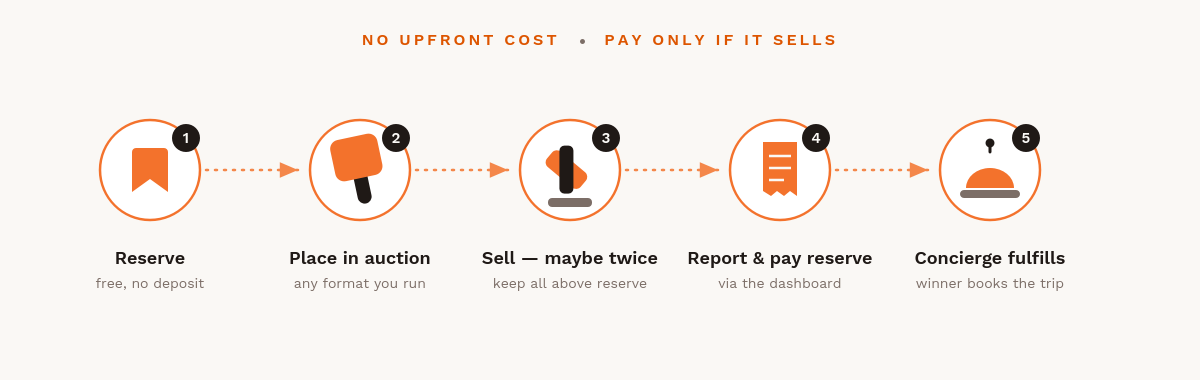
Browse and reserve. You pick packages from the provider's catalog that fit your audience and theme. Reserving is free; there's no deposit and no obligation to buy if bidding never reaches the reserve.
Place it in your auction. Items arrive catalog-ready — professional description, photos, and a stated retail value you can drop straight into your event listing. They work in live, silent, online, and hybrid auctions, and many can be run as a raffle or a fixed-price "buy it now."
Sell it (sometimes more than once). Many packages can be sold multiple times in the same event. If three bidders are all willing to pay above your reserve, you don't have to disappoint two of them — you can fulfill all three and multiply the revenue off a single listing. Each catalog item tells you how many times it may be sold.
Report and pay. After the event you enter the winning bid(s) in the provider's dashboard and pay the reserve(s).
Fulfillment is the provider's job. The winner receives a voucher or certificate with redemption instructions, then works directly with the provider's travel concierge or redemptions team to book dates and handle logistics. You're not playing travel agent, and you're not on the hook for the guest experience.
What to check before you commit
Providers vary more than their marketing suggests, so a little diligence pays off:
True cost and fees. The reserve price should be stated clearly with no surprise markups, platform fees, or card-processing fees layered on at checkout. Confirm the number you see is the number you'll pay.
Redemption window and blackout dates. Most travel packages give the winner a booking window of roughly 18 to 24 months. Any blackout dates should be disclosed to you and your donors upfront — vague terms here are the fastest way to a disappointed winner.
Fulfillment quality. Your donor just spent thousands; their post-event experience reflects on you, not the vendor. Look for providers with real concierge support, winner reviews, and a track record with organizations like yours.
Authentication, for memorabilia. Signed sports or entertainment items should come with recognized certification (JSA, PSA/DNA, Beckett, or Fanatics). Skip anything that can't prove it.
Platform independence. You generally don't have to adopt a provider's auction software to use their items — most let you layer consignment lots into the auction setup you already run. (Some bundle catalog and software together; that's a convenience, not a requirement.)
How to use it well
Consignment is a scalpel, not a sledgehammer. The point is to fill the handful of marquee slots — usually your top live-auction lots — that donated items can't reliably cover, not to stock the whole table. Keep the number limited so the premium items stay special and don't crowd out the local, mission-aligned pieces that give your auction its character.
The teams that get the most out of it treat a consignment package as a centerpiece: feature it as the headline live lot, build a paddle-raise or fund-a-need moment around it, and spotlight it in pre-event marketing so bidders show up already wanting it. Paired with a strong base of donated and local items, a few well-chosen consignment lots are what turn a solid auction into a record-breaking one.
Why this works with the tools you already use
Notice the assumption baked into the whole consignment model: the items slot into the auction you're already running. You don't adopt a new system, migrate your data, or ask donors to learn another checkout — you layer a few marquee lots on top of what you've got. That's the same principle Gala Season is built on. Your event page, your donation and ticketing tools, and your existing workflow stay exactly where they are; Gala Season gives your cause a home and a stage around them, without forcing you to rip anything out. Sourcing great items and running a great event shouldn't require throwing away what already works for you.
Method 5: Lead with experiences, not stuff

A theme runs through all of this: experiences outperform objects. Many donors already have enough things; what they'll bid aggressively on is a memory — a chef's table, a behind-the-scenes tour, a weekend away, courtside seats, a private lesson with someone they admire.
Experiences also tend to cost the donor less to give than their perceived value, which is a rare win-win. When you're building your wish list, weight it toward the experiential end. It's where the energy in the room goes.
How organizations stay organized now
Sourcing is half the job; tracking it is the other half. A few habits separate the smooth auctions from the chaotic ones:
Procurement packets. Strong teams hand every prospective donor a tidy packet: the item wish list, a donation request letter, and an in-kind donation form. It looks professional, makes the ask easy to say yes to, and keeps the internal team aligned on who's asking whom.
A central tracker. A shared spreadsheet (or your auction software) logging each item, its donor, value, status, and who owns the follow-up. This prevents the classic disaster of two board members soliciting the same restaurant.
Donation directories. In-kind directories that aggregate which companies give and how to apply can save hours of research — especially for the corporate-program route.
An early start. Almost every experienced organizer says the same thing: begin sooner than you think you need to. The best items require lead time to request, follow up on, and confirm, and the teams that start early are the ones still calmly adding lots while everyone else is scrambling the week before.
Putting it together
There's no single source for a great auction — there's a mix. Most of your catalog will come from your own network and local businesses. A few standout lots will come from corporate programs you applied to months ago. And the marquee items at the top, the ones that make the room go quiet, increasingly come from risk-free consignment.
It helps to see how the two big buckets — donated and consignment — actually compare on the economics:
Donated items | Consignment items | |
|---|---|---|
Upfront cost | None | None |
Who supplies them | Your network, local businesses, corporate giving programs | Specialized third-party providers |
Effort to acquire | High — many asks, follow-ups, and tracking | Low — browse a catalog and reserve in minutes |
Value ceiling | Whatever a donor is willing to give | Whatever a donor is willing to give |
What your cause keeps | 100% of the winning bid | Everything above the reserve price |
Financial risk | None, but unfilled slots leave gaps | None — unsold items return to the catalog free |
Fulfillment | You coordinate delivery and the guest experience | The provider's concierge handles it |
Best used for | The bulk of the catalog and your local character | A handful of marquee, headline-grabbing lots |
The takeaway isn't that one beats the other — it's that they do different jobs. Donated and local items give your auction its heart and fill most of the table at zero cost. A few consignment lots give it a ceiling high enough to drive your biggest moments of the night. Build from both.
What ties it all together is intention: knowing your donors, deciding what you want before you ask, and keeping the whole effort organized enough that nothing falls through the cracks. Do that, and the auction table stops being the thing you worry about and starts being the thing your guests can't wait to get to.