
Ask ten development directors how they set their gala ticket price and most will give you some version of the same answer: "We charged about what we charged last year, maybe a little more." The brave ones admit they picked a number that "felt right" for their crowd.
That instinct isn't wrong, exactly but on its own it's how galas end up as expensive dinners that barely clear a profit. A ticket price isn't a vibe, and it isn't a lever you crank until the math hits your goal. It's one input in a short plan. Get the plan right and almost every other decision tiers, tables, sponsorship asks gets easier.
This guide walks through that plan, the benchmarks to sanity-check it against, and the structure that lets a well-run gala net 70 cents on every dollar instead of 40.
Start with the goal, not the ticket
Here's the reframe that changes everything: the only number that matters is net what's left for your mission after every cost is paid. Everything else is just a lever you pull to get there.
So don't begin by asking "what should a ticket cost?" Begin with three questions, in order:
What do we want to net for the mission?
What will the night actually cost us?
How many seats will we realistically sell one at a time?
Those three frame the whole budget. But notice what isn't on the list: "what price makes tickets cover the goal?" That question is the trap. If you size the ticket to close the gap by itself, you'll either land on a number nobody will pay, or quietly give up on the goal. The ticket price and the goal are two different jobs.
Price the ticket to the room, not to the goal
Set your ticket price for the guests in the room — what people at your event, in your city, for your cause will comfortably pay. That's a market question, and the market clusters in predictable bands:
$100–$250 is typical for most nonprofit galas.
Up to ~$500 a head is common for established events in major metros, or where the night includes a premium meal and headline entertainment.
Marquee and high-society events can run higher still — $1,000 to $1,500 a seat — but that ceiling rises with the scale and prestige of the event, not with how big your goal is.
Tables generally run $1,000–$5,000 for eight to ten seats, usually at a modest premium over the same seats bought individually.
The right answer is usually a range, not a single number. Price toward the low end and you lean harder on sponsorships; price toward the high end and you ask more of each guest. A healthy target is for tickets to land around a quarter to a third of total revenue — enough to cover the room, not so much that the whole night rides on attendance. If the price you'd need to "make goal" sits well above these bands, that's not a pricing answer — it's a signal that your sponsorship plan is too thin.
The real formula: size sponsorship to the gap
Once the ticket is priced for the room, work backward to find the number that actually has to close your goal — and it isn't the ticket. It's sponsorship.
(Total event cost + net fundraising goal) − ticket revenue − other revenue = sponsorship you need to raise
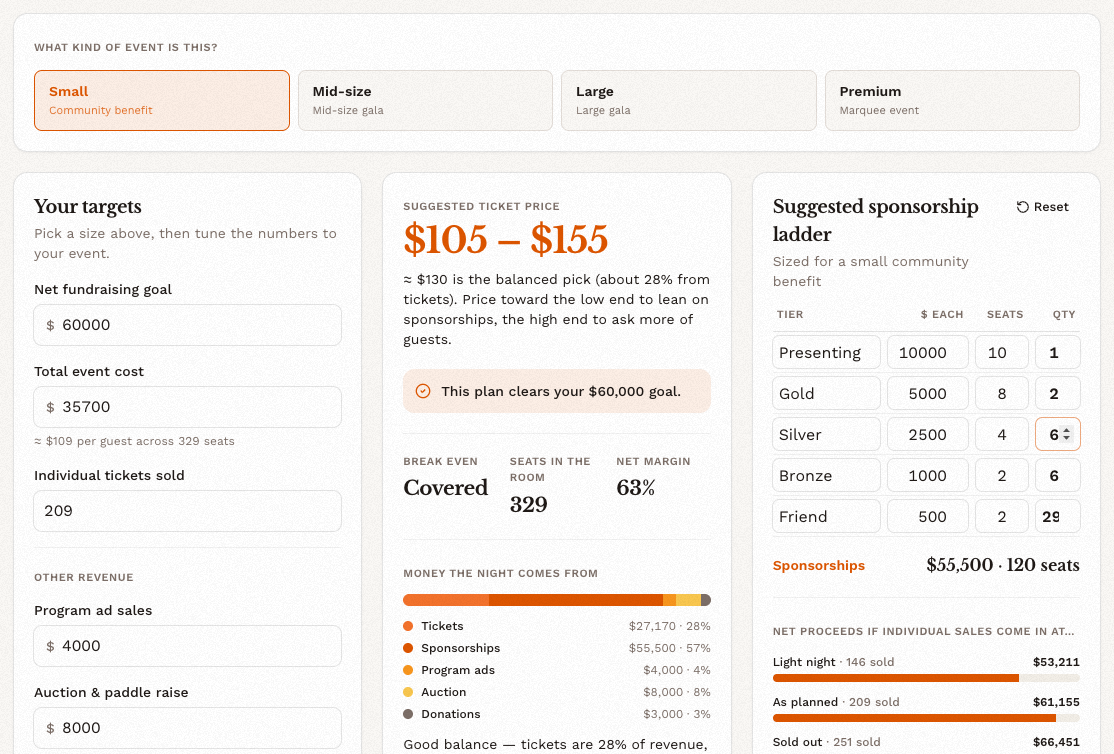
Say your night costs $35,000 and you want to net $60,000 — so the evening has to generate $95,000 all in. Your ticket sales realistically bring in about $27,000, and you expect another $15,000 from program ads, the auction, and the paddle raise. That leaves roughly $53,000 for sponsorship to carry. That's the number your sponsorship ladder is built to hit — and if it feels big, the answer is more sponsors or bigger packages, never a $600 ticket at a $200 event.
There's an encouraging flip side. Because sponsorship and the auction are largely fixed before a single guest buys a ticket, a well-sponsored gala often covers its entire event cost before individual ticket sales even begin. Past that break-even point, every ticket sold is pure progress toward the mission.
Rather not run this by hand? Our free gala ticket & sponsorship planner does exactly this as you type — pick your event size, and it suggests a realistic ticket-price range, sizes a sponsorship ladder to close your goal gap, and tells you live whether the plan actually clears.
Watch the denominator: sponsor seats aren't ticket sales
Here's a subtle trap that throws off a lot of gala budgets. Sponsorship packages almost always include seats — a $25,000 presenting sponsor might get a table of ten, a $1,000 friend a pair of seats. Those guests are already paid for, through the sponsorship. They fill chairs and eat dinner, but they don't buy an individual ticket.
So when you estimate ticket revenue, count only the seats you'll actually sell one at a time — not your total headcount. If 66 of your 234 seats go to sponsors, only 168 are paying the ticket price. Counting all 234 as ticket buyers quietly inflates your ticket revenue and leaves you short on the night. (Those same seats also trim what your sponsors can deduct — more on that below.)
Why your ticket price isn't your main revenue lever
This is the part that surprises first-time gala planners: in a healthy gala, ticket sales are not the engine. They're closer to the cover charge.
The pattern at high-performing galas looks roughly like this:
Ticket and table sales: 20–30% of total revenue — enough to cover the cost of the room.
Sponsorships and the live program (paddle raise, fund-a-need, auction): 50–60% — the real fundraising.
The takeaway isn't "tickets don't matter." It's that you should price tickets to comfortably cover the room and a cushion, then put your real energy into sponsorship and the giving moment. Aim to keep total expenses under 30% of gross, so at least 70 cents of every dollar reaches the mission.
How to build your ticket tiers
A single flat price leaves money on the table. A simple tiered structure captures more without alienating anyone:
Early bird — roughly 15% below standard, for a limited window. Rewards your most committed supporters and front-loads the cash flow that pays your deposits.
Standard — your core price, the one most guests pay.
VIP / patron — 40–50% above standard, bundled with something genuinely better: a pre-event reception, premium seating, time with leadership or an honoree.
Table sponsor — eight to ten seats at a premium, often the easiest sell to a board member who'd rather buy a table than chase eight friends.
Consider a discounted young professional or student rate, too. You'll net less per seat, but a 28-year-old in the room tonight is a major donor in fifteen years — and an empty seat earns nothing.
Structure your sponsorship tiers like a menu
Since sponsorships do the heavy lifting, make them effortless to say yes to. Keep it to four or five named tiers, each with a clearly defined package — a set number of seats, logo placement, recognition from the stage, social mentions. A business owner should be able to scan the options and pick one in thirty seconds.
A typical ladder looks something like this:
Presenting — ~$25,000 — 2 tables (20 seats), top billing, logo everywhere
Gold — ~$10,000 — 1 table (10 seats), prominent recognition
Silver — ~$5,000 — most of a table (8 seats), program and stage mention
Bronze — ~$2,500 — 4 seats, listed in the program
Friend — ~$1,000 — 2 seats, name in the program
Two things to keep in mind as you build it. First, the shape is a pyramid: you'll usually land just one presenting (or title) sponsor, a couple at the next tier, and more as you move down — so don't budget for four presenting sponsors. Second, every tier includes seats, which is the part that quietly reshapes your ticket math, since those guests don't buy individual tickets. Start the asks early, too: sponsorship is the highest-margin revenue you have, and the best prospects commit months ahead — begin at least six months before the event, well before tickets go on sale.
The tax detail most organizers miss: fair market value
Here's the one that trips people up every year. When a guest pays for a gala ticket, they don't get to deduct the whole thing. They can only deduct the portion above the fair market value (FMV) of what they receive in return — the meal, the drinks, the entertainment. The IRS calls this a quid pro quo contribution.
A quick example: a guest buys a $250 ticket, and the FMV of the dinner and entertainment is $100. Only $150 is tax-deductible.
What this means for you:
Estimate the FMV of each ticket in good faith — your per-guest catering and entertainment cost is a reasonable starting point.
State the deductible amount on invitations and receipts. Donors need it for their records, and getting it wrong creates compliance headaches.
The same logic applies to sponsorships: if a sponsor receives advertising or tickets in return, only the amount above that value is deductible.
None of this is tax advice — confirm the specifics with your finance lead or accountant — but pricing without accounting for FMV means your receipts will be wrong, and your donors will notice.
Don't let the platform quietly eat your margin
One last number that belongs in your math from the start: payment processing. Whatever platform you use to sell tickets and collect pledges takes a cut of every transaction — and a few percent across tickets, table sales, auction bids, and paddle-raise pledges adds up to real money by the end of the night.
There are two honest ways to handle it: build the fee into your ticket price (gross it up so your net is what you actually need), or choose a platform that keeps more of each dollar in your pocket. Either way, decide before you set your goal — discovering the fees afterward is how a gala "hits goal" on paper and still comes up short for the mission.
A worked example, start to finish
Let's put it together. A children's education nonprofit is planning its annual gala — a large event for a room of about 230.
Start with the room. Tickets for a gala this size sensibly land somewhere in the $130–$200 range; they settle on $165 as the standard seat. They expect to sell 168 seats individually.
Estimate the other revenue. Program ads bring in $4,000, the live auction $8,000, and the paddle raise $3,000 — $15,000 in non-sponsorship, non-ticket revenue.
Find the gap. The night costs $35,700 to produce and they want to net $60,000, so the evening has to generate $95,700 all in. Tickets contribute about $26,900 (after a 3% processing fee), and other revenue $15,000 — which leaves roughly $53,800 for sponsorship to carry.
Build a ladder that fills it:
Presenting — $25,000, 20 seats — 1 sponsor → $25,000 / 20 seats
Gold — $10,000, 10 seats — 1 sponsor → $10,000 / 10 seats
Silver — $5,000, 8 seats — 2 sponsors → $10,000 / 16 seats
Bronze — $2,500, 4 seats — 3 sponsors → $7,500 / 12 seats
Friend — $1,000, 2 seats — 4 sponsors → $4,000 / 8 seats
That's $56,500 in sponsorships across 66 sponsor seats — enough to close the $53,800 gap with a little cushion.
Now the room comes together: 168 individual seats + 66 sponsor seats = 234 in the room. Total event cost works out to about $153 a guest. At full attendance they clear the $60,000 goal with room to spare — and even if individual sales come in soft, sponsorships and the program have already carried the fixed costs.
Notice the shape, too: tickets bring in about 28% of total revenue, with sponsorships at roughly 57%. That's the healthy split — and it's exactly what a strong sponsorship ladder buys you. The $165 ticket can stay accessible precisely because sponsors and the live program are doing the heavy lifting.
Quick answers
How much should gala tickets cost? Most nonprofit gala tickets fall between $100 and $250, with established or major-metro events reaching $500 and marquee events going higher. But the right price for your gala is a range set to what your guests will pay — not the number that would make tickets cover your goal on their own.
If the ticket doesn't close the goal, what does? Sponsorship. Add your total event cost and net goal, subtract your expected ticket and other revenue, and what's left is the sponsorship you need to raise. That gap is what your sponsorship ladder is built to fill — and most of a gala's real fundraising lives there, not in the ticket price.
What percentage of a gala ticket is tax-deductible? Only the amount above the fair market value of what the guest receives. If a $200 ticket includes $80 of dinner and entertainment, $120 is deductible. Always state this on receipts.
Should ticket sales be my biggest revenue source? No. In a well-structured gala, tickets cover the cost of the room (about 20–30% of revenue) while sponsorships and the live giving program do the real fundraising (50–60%).
Pricing is the first decision of a great gala — selling those tiered tickets, tables, and sponsorships shouldn't be the hardest. Gala Season gives nonprofits one place to build an event page, sell every ticket tier, and bring in sponsors, so more of every dollar reaches your mission.


