
Every event produces some version of this night.
The honoree is beloved. Thirty years with the organization, a real champion of the cause, the kind of person whose name draws warm nods from everyone already in the room. The tribute is moving, the remarks land, and guests leave saying it was a lovely evening. Revenue comes in flat against last year.
Nothing went wrong, exactly. The trouble started nine months earlier, in the meeting where someone asked who deserves to be honored this year. Everyone answered sincerely. Nobody asked the second question.
The award trap
Think of an honoree less as an award and more as a door into a network.
That framing deserves some care, because the honor should be real. Organizations that hand out recognition purely as a fundraising instrument tend to get found out, first by the honoree and eventually by everyone else. Merit still comes first.
But in any organization's orbit there are usually several people who deserve recognition, and you are choosing among them. What you choose on determines whether the evening funds your programs or just celebrates them. So the question underneath the question is which of these deserving people has a circle that will actually show up.
Five types of honoree, and what each one delivers
Honorees don't all do the same job, and knowing which type you've picked tells you what to expect from the night.
The corporate executive brings their company's table, and often the tables of two or three peer firms whose leaders would rather not be conspicuously absent when a colleague is honored. Of the five types this is the most dependable for revenue, as long as the ask lands in time for the company's giving cycle.
The board member or major donor brings a personal circle: friends, neighbors, family, people who show up for them rather than for you. Often the highest-yielding honoree available to an organization, and often overlooked, since boards tend to be shy about honoring their own.
The public figure draws press, photographers, and ticket sales from people with no prior connection to your work. What they rarely bring is tables. A celebrity honoree can lift your profile while barely moving revenue, which is fine if that was the trade you meant to make.
The mission honoree is the longtime volunteer, the frontline staff member, the person your organization exists to serve. Direct revenue is close to zero. They are also the emotional center of the evening and often the reason a first-time guest turns into a donor, which is why cutting them to make room for a bigger name so often backfires.
The corporate honoree is a company rather than a person. It converts cleanly into sponsorship, being a marketing decision with a marketing budget behind it, though it delivers the least emotional lift and makes for a harder tribute.
Galas that both raise money and feel like an occasion usually pair a revenue honoree with a mission honoree. Pick only the first and you get a profitable evening nobody remembers. Pick only the second and you get a beautiful evening that loses money.
Vetting, before you ask
Three checks once you have a name.
Start with reputational due diligence: an hour of searching, plus a conversation with whoever on your board knows the person professionally. You're attaching your organization's name to theirs for a full year of solicitation materials, so pending litigation, a business in the middle of layoffs, or a controversy still working itself out are all reasons to wait a year. They are also much cheaper to find now than in March.
Then mission conflict. Does the honoree's business, or their investments, or something they've said publicly sit awkwardly against what your organization stands for? Staff will notice. Younger donors will notice. Better to decide with your eyes open than in the middle of a news cycle.
The third one almost nobody checks: is this person already being honored twice this season? It matters more than it sounds like it should. You aren't really competing for the honoree's time, you're competing for their list, and if the same friends and colleagues get three solicitations in one spring with the same name attached, the second and third convert at a fraction of the first. The honoree usually won't mention it, mostly because they haven't thought about it in those terms. Ask directly and ask early.
When to ask
Nine to twelve months out, for three reasons that all come down to sequencing.
Corporate giving runs on a calendar. If the honoree's employer is going to underwrite a table, that decision has to reach a budget cycle that closed months before you called. You also need their contact list before the save-the-date goes out, and building it, deduplicating it against your own file, and getting it into a first mailing takes weeks. And if you run a benefit committee, nobody joins one for an unnamed event. The honoree's name is what committee members use to recruit each other, and assembling a committee takes three or four months on its own.
None of that happens in parallel. Confirm late and the whole chain compresses into a scramble.
Who makes the ask
A peer should make it. Board member to board member, executive to executive.
Not a staff email, and not a development director cold-calling someone who has never heard of them. The standing of the person asking signals how serious the honor is, and an honoree recruited by someone they respect tends to behave like someone with skin in the game.
In practice the peer makes the call or takes the meeting, the executive director follows within a day or two with warmth and specifics, and written materials come last, once the answer is already yes in principle.
What you're actually asking for
This is where the money gets left on the table. The organization asks for a name and a date, the honoree says yes, and eight months later everyone wonders why the network never materialized.
There are seven things to ask for, and they should all be said out loud in the first real conversation.
Name and likeness in solicitation materials: invitations, the website, the program or journal, press.
Their contact list, with a clear understanding of who on it they'll approach personally and who your team can reach directly.
A personal appeal in their own voice. A letter or email over their signature, ideally something they helped write. It consistently outperforms anything the organization sends under its own name.
A commitment from them or their employer. A table, a sponsorship, an underwriting line. Awkward to raise, and far more awkward to raise in month eight. Honorees are rarely surprised by it.
One or two committee appearances. A kickoff and one push, not a standing obligation.
Bio, photographs, and participation in a tribute video if you're producing one. Set that deadline in the first conversation, since it's the item that runs late more often than any other. Plenty of organizations skip the video and run a live introduction instead, which asks less of everyone and often plays better in the room.
Remarks at the event, with a length attached. Four minutes, not fifteen.
Many organizations ask for the first and hope for the rest.
Put it in writing
An honoree brief covering what they receive, what's expected of them, and every deadline is worth more to have then to not, see here for an example.
Few organizations bother. It isn't a legal instrument and shouldn't read like one, though it can carry real specifics, including the pledge amount and a signature from each side, without turning into a contract. Recording what was agreed isn't the same as enforcing it. What the page actually prevents is the conversation in month seven where the honoree is surprised to learn you expected a letter over their signature, and the one in month nine where they're annoyed nobody mentioned the video shoot was in two weeks.
Send it after the yes, as a courtesy. Honorees who have been honored before tend to notice, since a fair number of them have accepted an honor and then spent a year guessing at what was expected.
What they get in return
The return side deserves the same specificity as the ask.
Recognition in the program or journal that their employer's marketing team will reuse. A tribute video, if you produce one, that their family will keep. Professional photographs. An introduction to a room of people they're glad to know. And an evening that runs well and ends when you said it would, which is rarer than it ought to be.
Do those well and the honoree becomes a donor, a board prospect, or the person making next year's ask on your behalf.
Measuring it, and the second-year rule
Afterward, trace tables and dollars back to the honoree's list. Not gross revenue for the night, but the specific attributable piece. Skip that and next year's selection meeting runs on impressions instead of evidence.
Then the second-year rule: don't go back to a network you've already tapped. An honoree's circle gives generously once. Asked again twelve months later they give less, and the year after that they stop opening the envelope. Rotating honoree types across seasons keeps opening new doors, which is the whole reason to choose carefully in the first place.
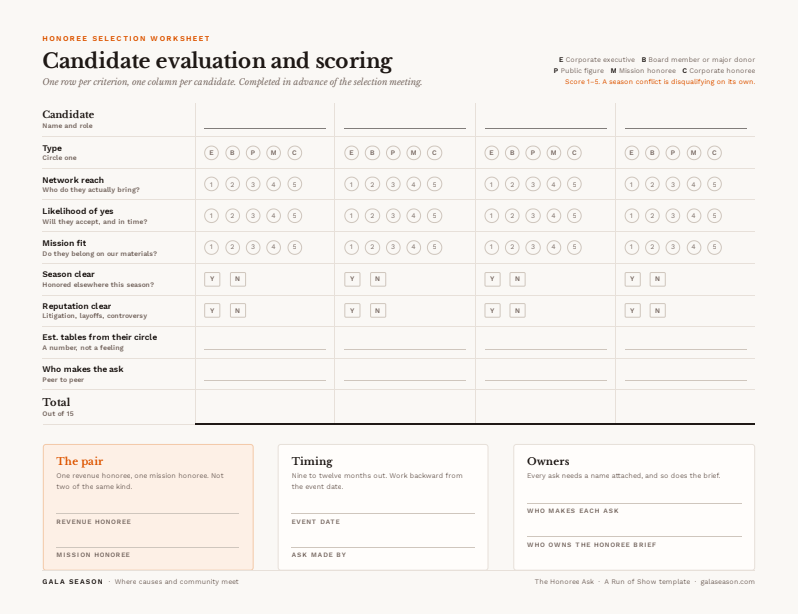
Download the Honoree Selection Worksheet (PDF)
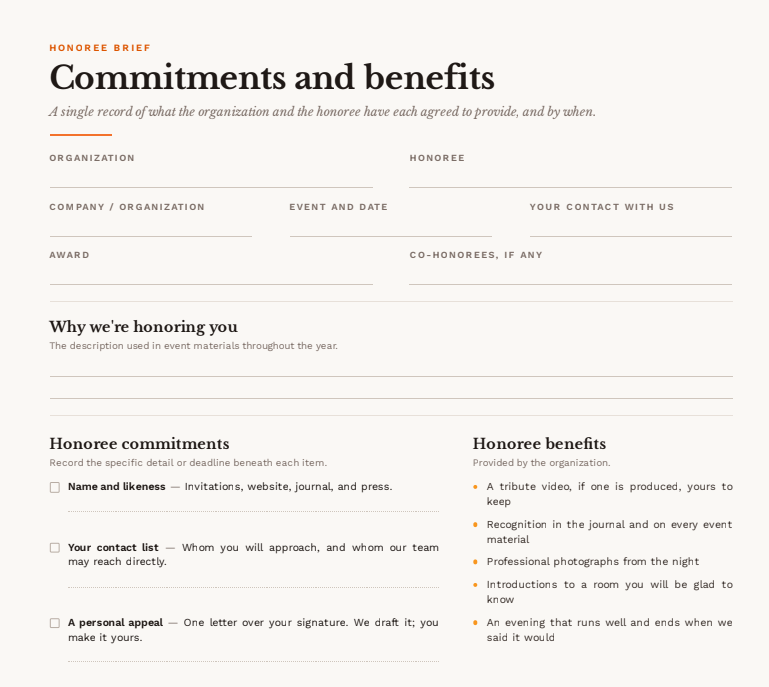
Download the Honoree Brief Template


