
Sit in on enough gala committee meetings and you'll notice a pattern: forty minutes debating who the honoree should be, then somewhere near the end, "and we'll do the usual crystal thing for the award." Meeting adjourned.
I get why. The honoree decision feels consequential and the award feels like procurement. But think about which one has the longer life. The honoree says yes, gives a speech, goes home. The award sits on their office shelf for the next fifteen years. It's in the stage photo that ends up on LinkedIn. It's the line in their bio. If anything, the object deserves more deliberation than it gets, not less.
So let's actually deliberate. Names first, then the thing itself.
The standard award names, and what each one signals
Most gala awards come from a fairly small menu, and honestly that's fine. A familiar name does real work. When the emcee says "Lifetime Achievement," nobody in the room needs the program notes to understand the honoree's stature.
Lifetime Achievement Award. The heavyweight. This is for someone at the end of a long arc: a retiring board chair, a founder, the volunteer who's been showing up for decades. It doesn't have to be someone inside your organization, either. Plenty of orgs give it annually to recognize a lifetime of service in the wider community, and that works well as long as the "lifetime" part stays true. The bar is the length and depth of the career, not how often you give the award.
Humanitarian of the Year. The workhorse. This is usually the one attached to your headline honoree, meaning the CEO whose company took three tables, or the philanthropist whose name anchors the invitation. You'll also see it as Philanthropist of the Year or Champion of Whatever-Your-Cause-Is.
Community Impact Award (or Community Service, same idea). One rung down in gravity, which makes it useful. It lets you honor a second person the same night without implying the two honorees are equals. Good for local business owners, civic leaders, program partners.
Corporate Partner Award. Given to a company and accepted by an executive, this one recognizes sustained corporate support: sponsorship, employee volunteering, in-kind help, or all three. It's also a genuine relationship moment, since public recognition tends to deepen a partnership rather than cap it. Name it plainly for what it honors. "Corporate Partner Award" or "Corporate Leadership Award" describes the relationship accurately, and the recognition lands better for it.
Volunteer of the Year. Often the actual emotional center of the program. People who check their phones during the corporate honoree's remarks will put them down for the person who drove the van every Saturday. If your run of show only has room for one tribute video, this is where I'd spend it.
Rising Leader Award. For someone earlier in their arc: a young professional building a giving circle, a committee member who took real ownership, an emerging voice in your cause. It signals where the honoree is headed as much as what they've done, and recipients often grow into board and leadership roles. Some organizations name it Emerging Leader or Next Generation Award.
Name the award after a person
Here's the upgrade almost nobody makes, and it costs nothing.
"The Eleanor Whitfield Humanitarian Award" beats "Humanitarian of the Year" every time. It carries institutional memory. It honors two people at once, the recipient and the namesake or their family, who now have a reason to attend every year and give accordingly. And it's genuinely harder to decline. Turning down a generic honor is easy. Turning down membership in a named lineage, where you can see the last twelve recipients listed in the program, is not.
Who should the namesake be? Your founder. A late board member. A legacy donor whose family is still engaged. (And the conversation where you ask that family for naming permission is itself a stewardship moment, so treat it like one.)
Two things to watch. Vet the namesake as carefully as you'd vet an honoree, because this is a permanent public association. And don't name everything. One named award in a program signals tradition; five signals a plaque factory.
While we're on naming: pull vocabulary from your own mission where you can. A "Beacon Award" means something at a maritime nonprofit. An "Excellence Award" means nothing anywhere. And avoid superlatives that create losers. "Best Volunteer" quietly insults every other volunteer in the room, while "Volunteer of the Year" just implies rotation. Same honor, very different room temperature.
Okay, the actual object
The award industry has its own vocabulary, and it's worth learning a little of it before you're pointing at a catalog page and hoping.
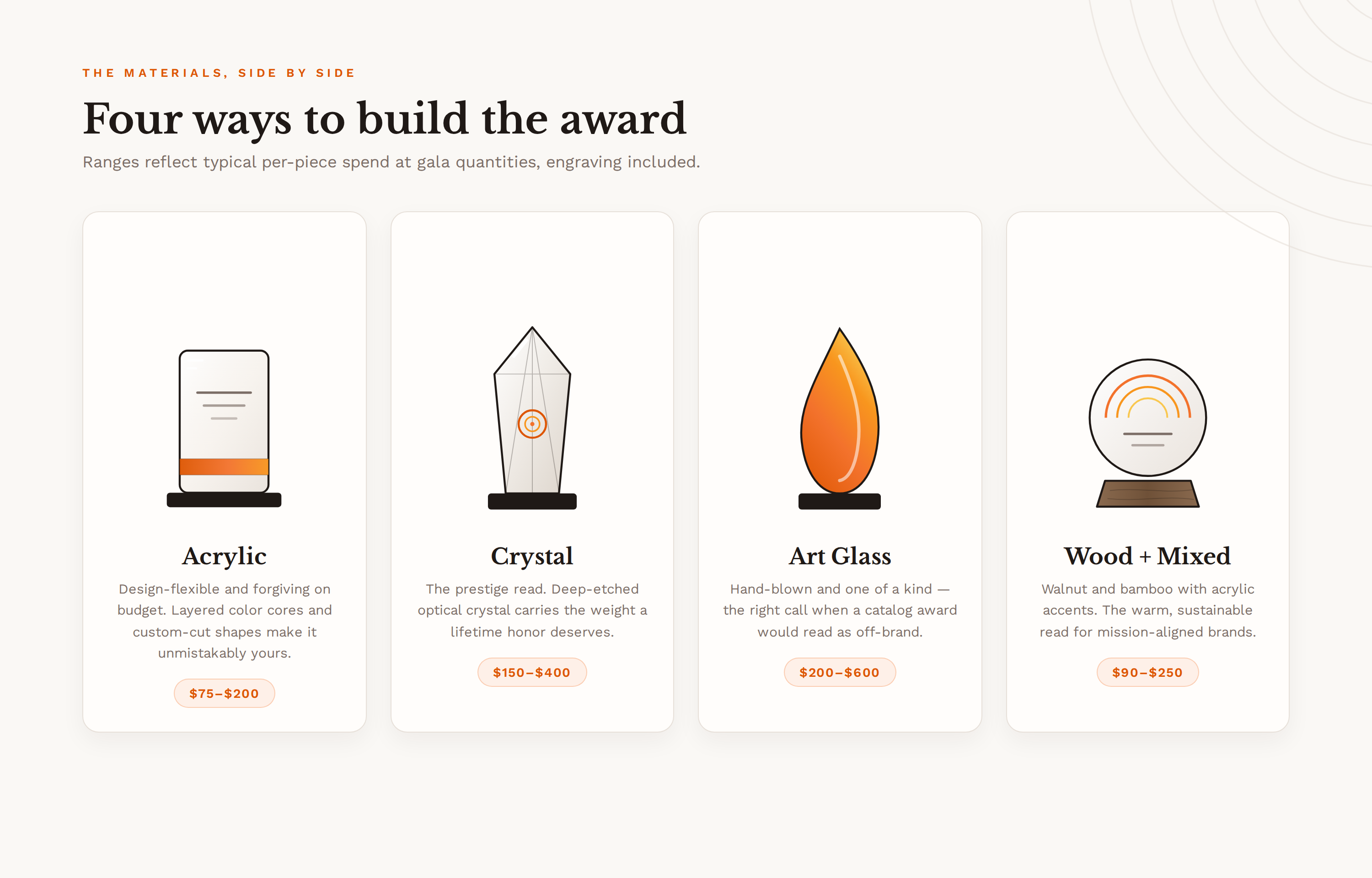
Acrylic (the trade also says Lucite) is where I'd start most organizations. It came up through the deal-toy world (those tombstone-shaped things investment bankers keep on credenzas) and it's the most design-flexible material at the most forgiving price. A few forms worth knowing:
The cast block with embedded print: your artwork sealed inside a solid clear block. Clean, modern, fine. The more interesting options are custom-cut shapes, since acrylic can be laser-cut into your logo mark, a torch, a house silhouette if you're a housing nonprofit, basically anything, which is where it beats crystal outright since crystal shape-work gets expensive fast. And color-layered acrylic, where a clear face is laminated over a colored core. Under stage lighting the colored edge glows, and if your brand colors are strong this is the cheapest possible way to make the award recognizably yours from thirty feet. Full-color UV printing on the face is the move when you need a photograph or detailed artwork rather than text.
At gala quantities, engraved, plan on $75–$200 a piece.
Crystal is the prestige read, and it's not just perception. Deep-etched optical crystal has a heft and clarity that acrylic can't fake, which is why lifetime achievement awards skew crystal. The trade-off is rigidity: you're mostly choosing an existing form (the flame, the tower, the faceted block, the globe) and engraving it. $150–$400 typically, more if you want a custom mold.
Art glass means hand-blown pieces, usually from a studio rather than a trophy house. Every piece comes out slightly different, which is either the entire point or a quality-control headache depending on your temperament. If you're an arts organization, though, handing your honoree a catalog award is a little off-brand, and this solves it. Budget $200–$600.
Wood and mixed materials. Walnut or bamboo bases, acrylic or metal elements, laser engraving. The warm, sustainable read. Right for land trusts, environmental groups, community foundations. Places where crystal would feel like a bank lobby.
And the plaque. Retire it. I don't care how nice the walnut is; a wall plaque says employee-of-the-month. If budget genuinely forces you under $75 a piece, a small acrylic block still beats a large plaque.
The details that separate an award from inventory
Engrave the recipient's name and the year. Not a printed sticker on a stock form. This sounds too obvious to write down. And yet: walk any executive's shelf and count. Personalization is the whole difference between an award and inventory.
Design for the photo, not the shelf. The award's biggest moment is the handoff photo on stage and its afterlife online. That means enough size to read at arm's length (8–10 inches for a headline award), a shape with a clear silhouette, and a finish that doesn't fire stage light straight back into the lens. Matte-edged acrylic and satin-finish crystal photograph noticeably better than high-polish everything.
Weight matters more than you'd think. Recipients register heft the instant the award lands in their hands, and they read it as significance. A hollow-feeling award undercuts whatever the tribute video just built. Given the choice between a bigger light piece and a smaller heavy one, take the heavy one.
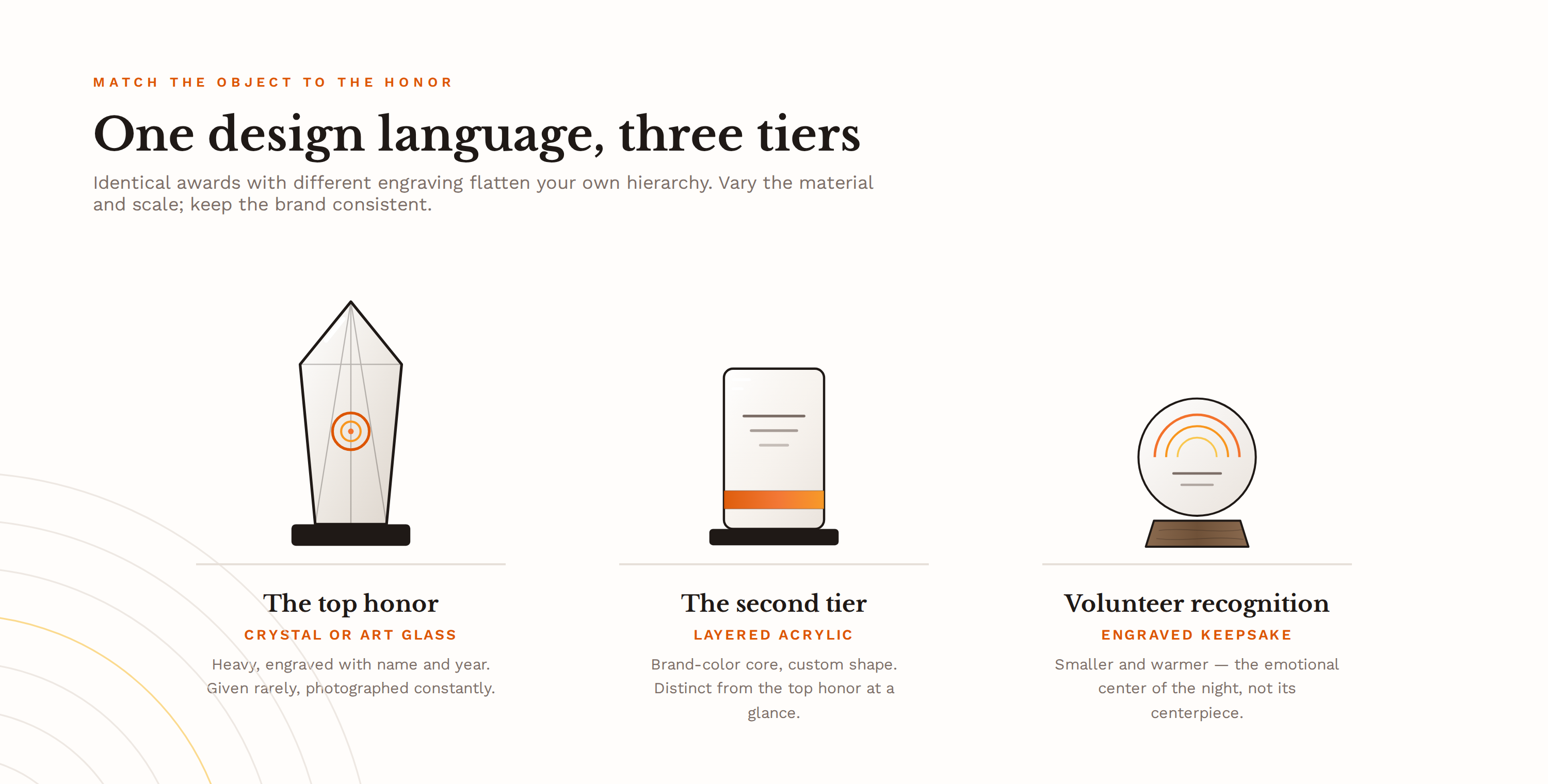
Don't give every honoree the same object. If your Lifetime Achievement honoree and your Volunteer of the Year get identical pieces with different engraving, you've flattened the hierarchy you spent all that program time building. The system I'd use: crystal or art glass for the top honor, layered acrylic in your brand colors for the second tier, a smaller engraved keepsake for volunteer recognition. Different objects, one design language.
Order early. Order a spare. Custom awards run three to six weeks, art glass sometimes longer, engraving errors happen, and honorees occasionally change three weeks out. The blank spare costs a hundred dollars and has saved more than one event.
Takeaway: The award outlives the event. Committees that treat the object as an afterthought are handing their most visible honoree a forgettable souvenir; committees that name the award, tier the materials, and engrave the details are building a tradition people compete to join.


